Project TST/FAC-UNB
The project for the preservation and modernization of the TST’s audiovisual collection: a transdisciplinary project of CIC – Communication, Information and Computing, stems from a research and development proposal to recover the historical memory of the Superior Labor Court (Tribunal Superior do Trabalh – TST), together with the Documentation Center (CeDoc) of the Faculty of Communication (FAC) of the University of Brasília (UnB), fitting into a larger transdisciplinary project for Memory Management in Communication and Information.
The project has two aspects: FAC/UnB – With the structuring of a preservation base (using Archivemática) and dissemination of information (using AtoM) that will enable the preservation of journalistic products, such as television news programs and Course Completion Papers (TCCs) that result in audiovisual materials, which today only have their textual preservation by the Central Library (BCE).
Another aspect that will be developed initially will be with the Superior Labor Court (TST) in the development of a repository for the Court’s image and audiovisual collection, with an interdisciplinary and multidisciplinary team to carry out the cleaning, digitization, and metadata identification of the collection already inventoried by the TST. After this stage, it will be prepared for dissemination with archival descriptions according to ISAG-D in AtoM by the project team under the supervision of TST technicians.
The materials to be digitized and described for AtoM:
2,600 DVcam-185me video tapes with 7,800 hours; 2,500 DVcam-124me video tapes with 5,000 hours; 6,000 miniDV-60me video tapes with 6,000 hours; 282 VHS video tapes with 1,128 hours; 11,382 video tapes with a total of 19,928 hours.
As a result, it is expected that all this digitized material will be updated and made available at https://labor-arq.tst.jus.br/index.php, in accordance with preservation standards and guidelines, and must comply with the guidelines and orientations of the TST’s Archival Classification Plan, which serves as the guiding instrument for making the digital objects available in AtoM.
Observations for the Project: Digitization: DVcam and MiniDV compatible equipment for digital tape playback, such as Sony decks with FireWire output, are disabled.
– VHS requires analog-to-digital converters, with attention to capture quality and color correction.
Format Preservation: Define which preservation formats, such as FFV1 or Matroska (MKV), will be used for the capture, with access copy in MP4/H.264.
– Each tape will be accompanied by technical metadata (format, duration, codec, resolution) and descriptive data (title, event, data, institutional context).
The initial equipment is already part of the FAC/UnB laboratory structure, with a multidisciplinary team of technicians, professors, interns, and scholarship holders for its execution.
This digital preservation project of the historical image collection of the Superior Labor Court (TST) represents an action of great social and institutional relevance. By digitizing, cleaning, and indexing films that document the history of the court, the initiative contributes to valuing the memory of the Labor Court—an institution officially created in 1946, with roots in the former National Labor Council, and whose mission is to guarantee workers’ rights in Brazil. The project’s impact is broad, reaching judges, staff, researchers, students, and specific citizens involved in the history of labor law and the work of the TST (Superior Labor Court). This initiative, from the Social Communication Secretariat (SECOM), linked to the structured General Secretariat of the Presidency (SEGP), reaffirms the TST’s commitment to transparency, the preservation of institutional memory, and the strengthening of informational citizenship.
OBJECTIVES
The main objective of the project is to equip CeDoc so that it can preserve the audiovisual memory of the TST (Superior Labor Court) and the journalism course. Disseminating the results at conferences, seminars, and scientific publications will be fundamental to sharing the advances and contributing to the sustainable development of information, potentially offering means to make the methodology replicable for all other collections in repositories to be created by the TST.
Sustainable Development Goals
By identifying and preserving the visual history of the TST, the project addresses several SDGs – Sustainable Development Goals, as presented below:
SDG 8: Decent Work and Economic Growth
Development of Professional Skills: empowering students and professionals for the job market, promoting full and productive employment and decent work. Innovation and Entrepreneurship: encouraging innovation and entrepreneurship in the field of Library and Information Science, contributing to sustainable economic growth.
SDG 17: Partnerships and Means of Implementation
Strengthening Partnerships: Establish and strengthen partnerships with national and international institutions, promoting the exchange of knowledge and best practices.
Specific Objectives
The project involves several actions and activities that are organized and guided by teams with different capacities and complementary skills, essential for collaborative, collective, and transdisciplinary work. The following is planned:
- Clean and identify the collection.
- Organize and execute the digitization of the TST’s audiovisual collection.
- Organize the visuality and navigation architecture of the AtoM system.
- Propose an updated information policy for the preservation of other image items not covered in this project.
- Guide the production of materials in the respective fields: Communication and Information Science, both for the production of tutorials for practical uses and for scientific articles, theses, dissertations, and monographs.
EXPECTED RESULTS
Mapping processes: This will enable the creation of a workflow for migrating analog materials to digital formats and preserving them in an open access repository.
Strengthening the Network: Strengthening the educational and research network in the area of Communication and Information Science, promoting collaboration between institutions. This will be possible with the planned equipment acquisitions and the formation of a specialized team, which will be able to continue the FAC collection, improving its current repositories.
Academic Production: Generation of scientific articles and research reports based on the collected and analyzed data, contributing to the advancement of knowledge in the area. The publication of reports and articles, as well as participation in events, will provide not only the dissemination of this research, but also the possibility of using a technology that will serve researchers from various countries.
Perspectives on internal training for the proposal:
In Library Science: 1 Final Course Project and/or 2 PIBIC
In Journalism: 1 Final Course Project and/or 2 PIBIC (Institutional Scholarship Program for Scientific Initiation Scholarships)
In Audiovisual: 1 Final Course Project and/or 2 PIBIC
In Archival Studies: 1 Final Course Project and/or 1 PIBIC
Preliminary Results of Academic Production:
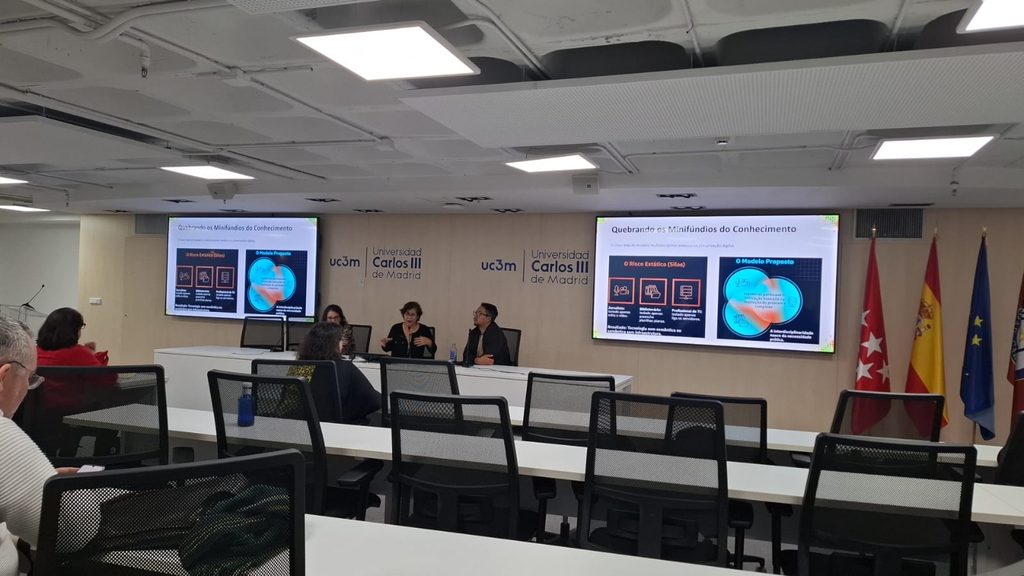
Dra. Mônica Regina Peres and Dr. Luz C. F. de Assumpção presented the article “Audiovisual Collection Preservation and Interdisciplinarity: A Report on the FAC and TST Agreement” at the XV Hispano-Brazilian Seminar on Research in Information, Documentation and Society, October 6-9, 2026 — Madrid, Spain, in the area of Memory, Preservation and Digital Humanities. This article aimed to map the multidisciplinary technical competence areas of the team from the perspective of generating knowledge in an interdisciplinary way through the execution of the project.
Abstract
This article analyzes the convergence between the domains of Communication, Information and Computing (CIC), from the perspective of Information Science (IS), and in the context of the agreement for the preservation and modernization of the audiovisual collection of the Superior Labor Court (TST), coordinated by FAC/UnB. The project faces the technical and documentary challenge of safeguarding more than 11,000 analog tapes (approximately 20,000 hours of recordings), using the open-source software AtoM for description and dissemination of information. The theoretical-conceptual framework was based on the epistemology of the disciplinary continuum, the classic interfaces of Information Science, and the interdisciplinary perspective of contemporary management guidelines based on mobile and flexible competencies. A bibliographic and empirical methodological configuration was adopted, structured from a diagnosis of the competencies and training needs of the team involved in the project through an online questionnaire. The results present a detailed diagnosis of the team and an integrated discussion of this data in accordance with the precepts of organizational flexibility and the limits of each member’s specialties. It is demonstrated that the success of digitization, preservation, and accuracy of thematic representation through metadata depends on the dynamic planning of the teams. The project concludes that the transition from a static multidisciplinary regime to an active interdisciplinary regime is feasible through flexible management based on mobile competencies.
Keywords: Information Science. Interdisciplinarity. Audiovisual Preservation. Metadata and Descriptors. Competency Analysis.
Resumo
Este artigo analisa a convergência entre os domínios da Comunicação, Informação e Informática (CI), sob a perspectiva da Ciência da Informação (CI), e no contexto do acordo para a preservação e modernização do acervo audiovisual do Tribunal Superior do Trabalho (TST), coordenado pela FAC/UnB. O projeto enfrenta o desafio técnico e documental de salvaguardar mais de 11.000 fitas analógicas (aproximadamente 20.000 horas de gravações), utilizando o software livre AtoM para descrição e disseminação da informação. O referencial teórico-conceitual baseou-se na epistemologia do continuum disciplinar, nas interfaces clássicas da Ciência da Informação e na perspectiva interdisciplinar das diretrizes contemporâneas de gestão baseadas em competências móveis e flexíveis. Adotou-se uma configuração metodológica bibliográfica e empírica, estruturada a partir de um diagnóstico das competências e necessidades de formação da equipe envolvida no projeto por meio de um questionário online. Os resultados apresentam um diagnóstico detalhado da equipe e uma discussão integrada desses dados de acordo com os princípios da flexibilidade organizacional e os limites das especialidades de cada membro. Este estudo demonstra que o sucesso da digitalização, preservação e precisão da representação temática por meio de metadados depende do planejamento dinâmico das equipes. O projeto conclui que a transição de um regime multidisciplinar estático para um regime interdisciplinar ativo é viável por meio de uma gestão flexível baseada em competências móveis.
Palavras-chave: Ciência da Informação. Interdisciplinaridade. Preservação de Audiovisual. Metadados e Descritores. Análise de Competências.

You may also like
Misinformation and false information
Online Learning in the USA